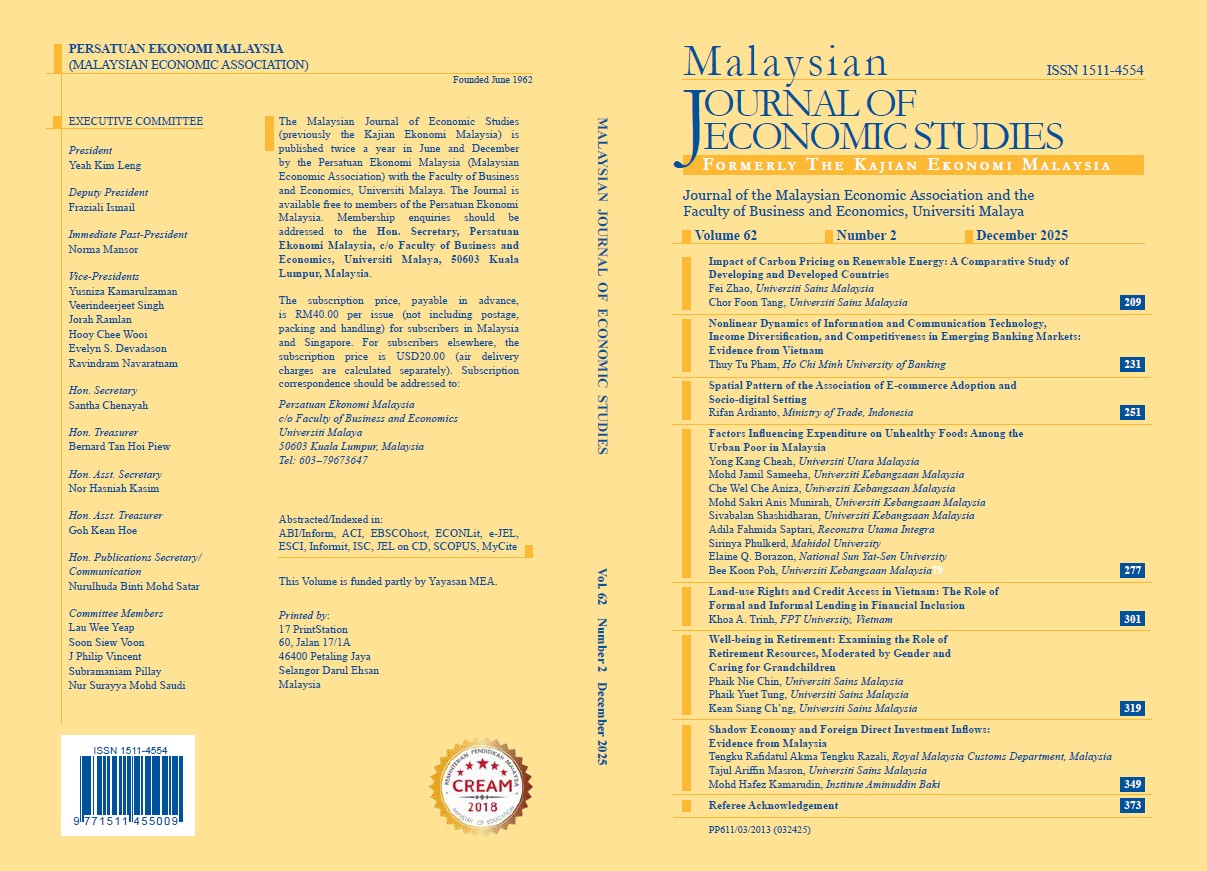
Factors Influencing Expenditure on Unhealthy Foods Among the Urban Poor in Malaysia

Authors

  • Yong Kang Cheah Universiti Utara Malaysia
  • Mohd Jamil Sameeha Universiti Kebangsaan Malaysia
  • Che Wel Che Aniza Universiti Kebangsaan Malaysia
  • Mohd Sakri Anis Munirah Universiti Kebangsaan Malaysia
  • Sivabalan Shashidharan Universiti Kebangsaan Malaysia
  • Adila Fahmida Saptari Reconstra Utama Integra
  • Sirinya Phulkerd Mahidol University
  • Elaine Q. Borazon National Sun Yat-Sen University
  • Bee Koon Poh Universiti Kebangsaan Malaysia

DOI:

https://doi.org/10.22452/MJES.vol62no2.4

Keywords:

Expenditure, poverty, sociodemographic factors, unhealthy foods, urban poor

Abstract

Consumption of unhealthy foods possesses harmful effects on health, thereby increasing the disease burden. If low-income people, especially those living in urban areas, do not make efforts to reduce their consumption on unhealthy foods, the health‒economic costs borne by them will rise. To date, there is a growing number of Malaysian studies that examine factors affecting consumption expenditure on unhealthy foods, but none has paid attention to the urban poor. The objective of this study is to narrow this research gap. A seemingly unrelated regressions model was utilised to estimate the effects of sociodemographic and health factors on expenditure of oil and fats, processed foods, sugar-sweetened beverages and alcoholic drinks. Income and household size were positively associated with expenditure on unhealthy foods. Individuals who were between 61 and 70 years old had higher expenditure on unhealthy foods than their younger counterparts. The Chinese spent less on certain unhealthy foods compared to the Malays. Being employed, having tertiary-level education, being married and living with chronic diseases increased spending on unhealthy foods. These findings suggest that the Malaysian government should consider increasing the tax on sugar-sweetened beverages and using health campaigns to educate the urban poor about the risks of unhealthy foods.

Downloads

Download data is not yet available.

Author Biographies

Yong Kang Cheah, Universiti Utara Malaysia

School of Economics, Finance and Banking, College of Business

Mohd Jamil Sameeha, Universiti Kebangsaan Malaysia

Centre for Community Health Studies (ReaCH), Faculty of Health Sciences

Che Wel Che Aniza, Universiti Kebangsaan Malaysia

Faculty of Economics and Management

Mohd Sakri Anis Munirah, Universiti Kebangsaan Malaysia

Centre for Community Health Studies (ReaCH), Faculty of Health Sciences

Sivabalan Shashidharan, Universiti Kebangsaan Malaysia

Centre for Community Health Studies (ReaCH), Faculty of Health Sciences

Adila Fahmida Saptari, Reconstra Utama Integra

Reconstra Utama Integra

Sirinya Phulkerd, Mahidol University

Institute for Population and Social Research

Elaine Q. Borazon, National Sun Yat-Sen University

International Graduate Program of Education and Human Development (IGPEHID), College of Social Sciences

Bee Koon Poh, Universiti Kebangsaan Malaysia

Centre for Community Health Studies (ReaCH), Faculty of Health Sciences

Downloads

Published

2025-12-30

How to Cite

Cheah, Y. K. ., Sameeha, M. J. ., Aniza, C. W. C. ., Munirah, M. S. A. ., Shashidharan, S. ., Saptari, A. F. ., Phulkerd, S. ., Borazon, E. Q. ., & Poh, B. K. . (2025). Factors Influencing Expenditure on Unhealthy Foods Among the Urban Poor in Malaysia. Malaysian Journal of Economic Studies, 62(2), 277–299. https://doi.org/10.22452/MJES.vol62no2.4

Issue

Section

Articles