
The evolution of 'kita-kita': A diachronic discourse analysis of pronominal reduplication in Standard Malay
DOI:
https://doi.org/10.22452/jml.vol36no1.3Keywords:
Corpus-based Analysis, Pronoun, Reduplication, Socio-political Perspective, Standard MalayAbstract
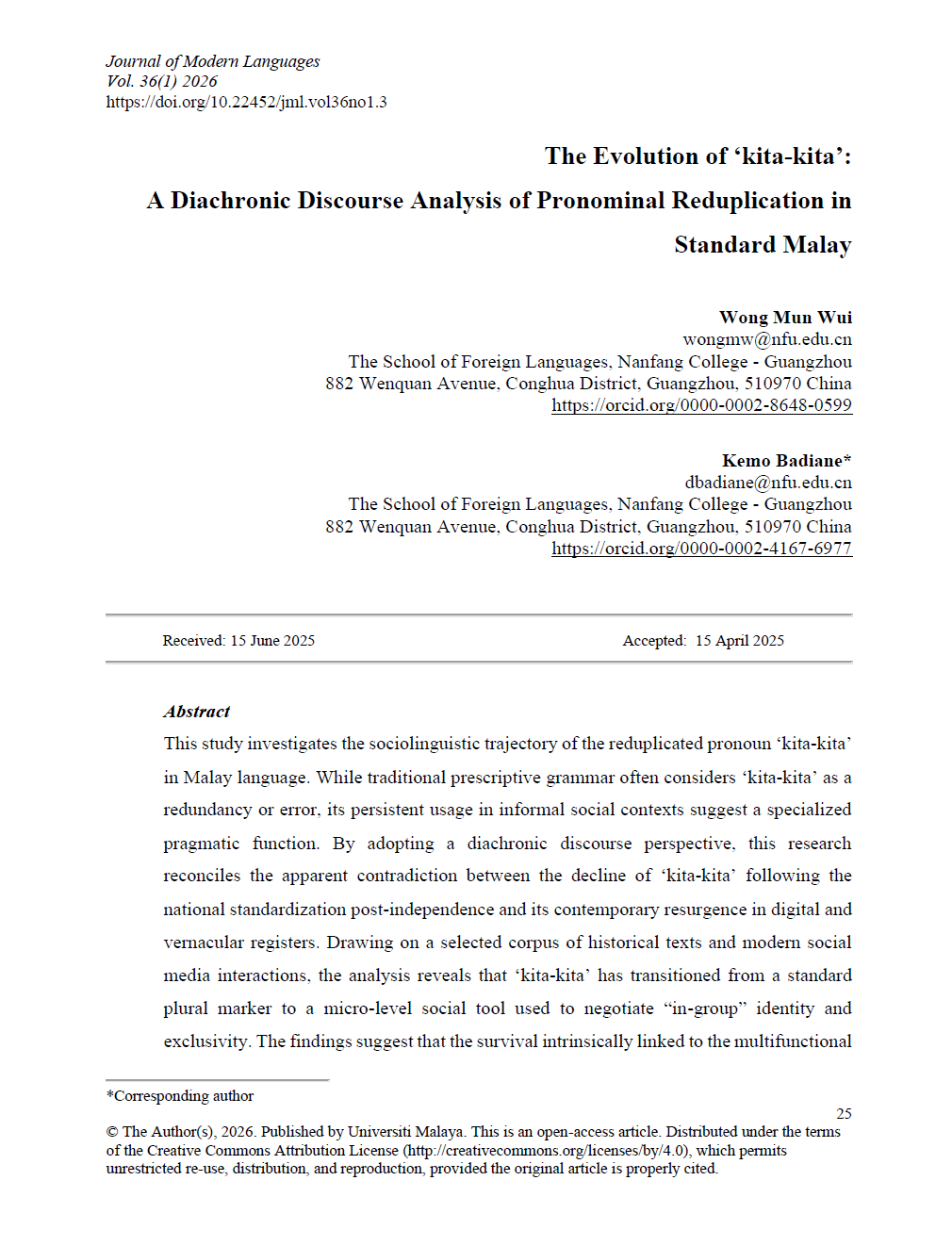
This study investigates the sociolinguistic trajectory of the reduplicated pronoun ‘kita-kita’ in Malay language. While traditional prescriptive grammar often considers ‘kita-kita’ as a redundancy or error, its persistent usage in informal social contexts suggest a specialized pragmatic function. By adopting a diachronic discourse perspective, this research reconciles the apparent contradiction between the decline of ‘kita-kita’ following the national standardization post-independence and its contemporary resurgence in digital and vernacular registers. Drawing on a selected corpus of historical texts and modern social media interactions, the analysis reveals that ‘kita-kita’ has transitioned from a standard plural marker to a micro-level social tool used to negotiate “in-group” identity and exclusivity. The findings suggest that the survival intrinsically linked to the multifunctional nature of Malay reduplication, facilitates language sustainability through its adaptability to changing socio-political landscapes. This study contributes to the broader understanding of how non-standard morphological forms persist as markers of social meaning despite formal linguistic pressures.
Downloads
Published
Issue
Section
Categories
License
Copyright (c) 2026 Mun Wui Wong, Kemo Badiane

This work is licensed under a Creative Commons Attribution-NonCommercial 4.0 International License.