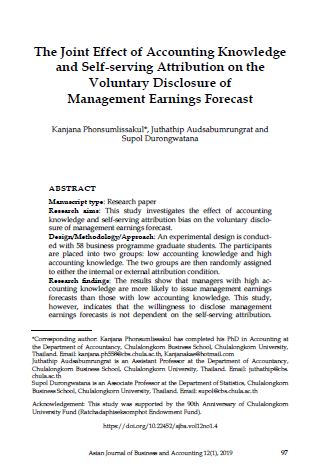
The Joint Effect of Accounting Knowledge and Self-serving Attribution on the Voluntary Disclosure of Management Earnings Forecast
DOI:
https://doi.org/10.22452/ajba.vol12no1.4Keywords:
Management Earnings Forecast, Attribution Bias, Accounting KnowledgeAbstract
Manuscript type: Research paper
Research aims: This study investigates the effect of accounting knowledge and self-serving attribution bias on the voluntary disclosure of management earnings forecast.
Design/Methodology/Approach: An experimental design is conducted with 58 business programme graduate students. The participants are placed into two groups: low accounting knowledge and high accounting knowledge. The two groups are then randomly assigned to either the internal or external attribution condition.
Research findings: The results show that managers with high accounting knowledge are more likely to issue management earnings forecasts than those with low accounting knowledge. This study, however, indicates that the willingness to disclose management earnings forecasts is not dependent on the self-serving attribution. Despite this, the findings illustrate that the joint effect of the accounting knowledge and self-serving attribution will influence the voluntary disclosure of management earnings forecast. Specifically, managers with low accounting knowledge are more likely to withhold information if the cause of the unfavourable performance is due to internal factors. In contrast, they are more willing to disclose their future earnings failure if it is due to external factors. This situation, nevertheless, does not apply to managers with high accounting knowledge who tend to issue future earnings information, regardless of the internal or external factor.
Theoretical contributions/Originality: This study delineates the boundary effect of accounting knowledge and self-serving attribution on management disclosure decisions. The results of this study reveal that self-serving attribution bias influences managers’ level of willingness in voluntarily disclosing management earnings forecast, under unfavourable outcomes.
Practitioner/Policy implication: The results of this study also reveal that high accounting knowledge can reduce the effect of self-serving attribution bias on managers’ judgment, thereby making it more practical for managers to acquire more accounting knowledge.
Research limitation: This study treats the level of accounting knowledge based on the number of accounting courses taken by the participants rather than testing their accounting knowledge per se.
Keywords: Management Earnings Forecast, Attribution Bias, Accounting Knowledge
JEL Classification: M41